Aero Kitchen and Bath – Custom Kitchen Cabinets and Renovations
Home / Accessories
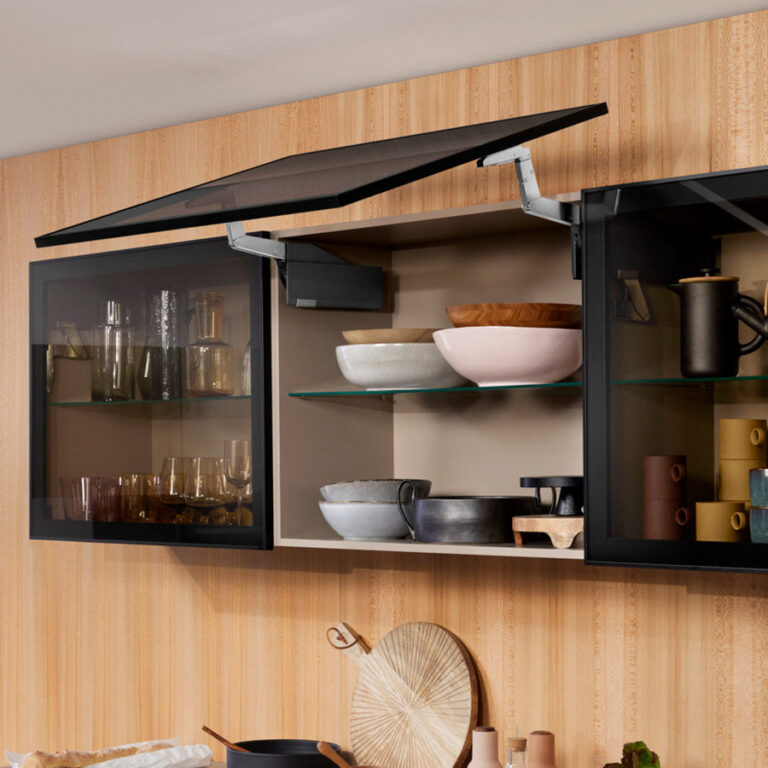
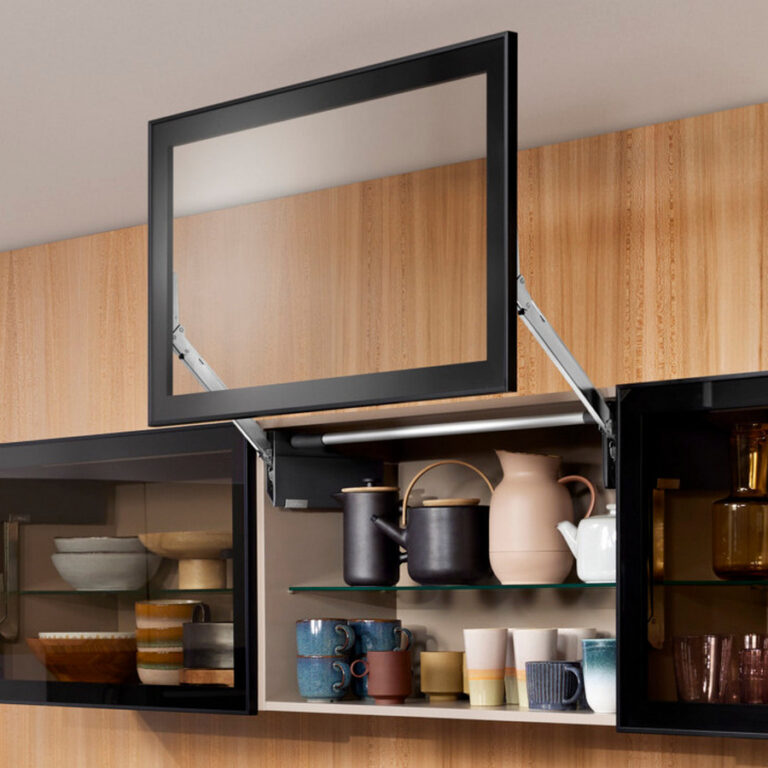
The whole front swings up and over the top of the cabinet in one piece, clearing the opening completely. The one to use on a tall wall cabinet where a swinging door would be in your way.
The front lifts straight up and stays parallel to the cabinet, so nothing swings out into the room. Useful above a run of counter, or where a wall cabinet sits close to a facing wall.
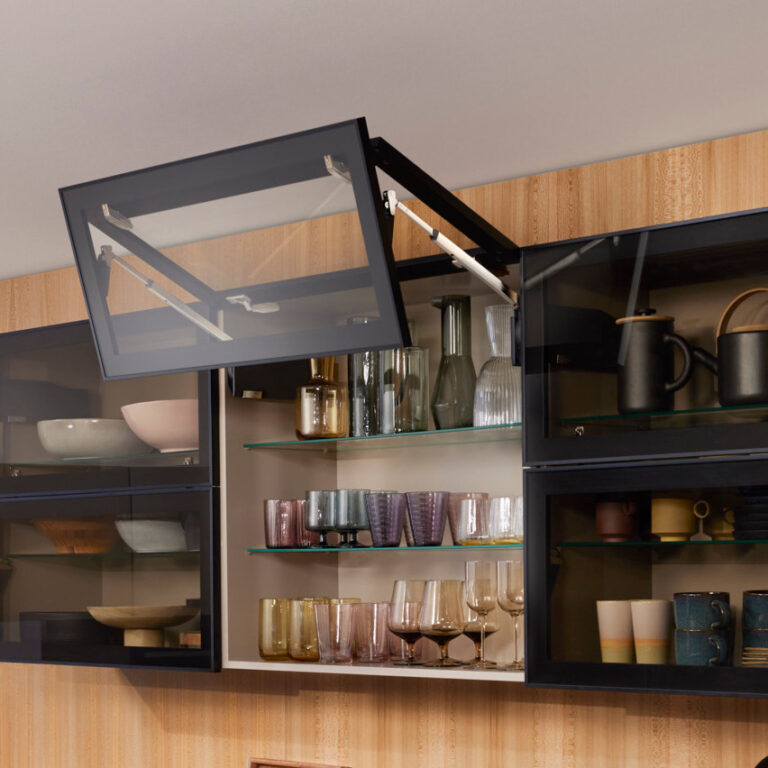
A two-piece front that folds together in the centre as it opens, so it stacks into half its height rather than swinging up in one piece.
A single front that lifts up and stays where you leave it. It covers both small and large fronts, for cabinets 205 to 600 mm high and up to 1800 mm wide, and takes door thicknesses up to 30 mm.
A compact stay lift for small and light fronts, such as the cabinet above a fridge or a larder unit. The 100 and 75 degree opening stops mean it needs little clearance above the cabinet, and it will take a cornice moulding.
The slimmest of the stay lifts. It needs only 100 mm of internal depth, which makes it the one for a shallow cabinet or the unit above a basin. One lift mechanism for a small light front, two for a heavier one.
The lift mechanism is set into the cabinet side panel rather than mounted on it, so nothing shows when the front is closed, including behind glass. It fits a side panel as thin as 16 mm and carries fronts up to 18 kg.
Two pairs of shelves on a hinged arm. Open the door and the back set swings out to the front, so the dead space behind the cabinet becomes reachable.
Kidney-shaped shelves that swing out one at a time and clear the cabinet frame, so nothing catches on the side wall on the way out.
A rotating shelf that turns as the door opens. Compact, and the easiest of the corner systems to use one-handed.
A three-quarter round shelf on a centre post. The traditional lazy susan, and still the cheapest way to make a corner usable.
A solid wood tray on a bearing plate instead of a centre post, so nothing runs up through the middle of the shelf. Comes in several diameters.
A ventilated insert with a roll-top cover, so bread is out of sight without being sealed in plastic. The cover rolls back into the drawer rather than lifting off.
Angled slots hold knives blade-down and apart, so edges do not knock together and nothing loose is sitting in a drawer you reach into.
Stepped rows put the back jars higher than the front ones, so you can read every label without lifting anything out.
A second tray slides over the first, so one drawer holds about twice as much. Everyday cutlery on top, serving pieces underneath.
Long compartments sized for spatulas, ladles and tongs. Cut to the drawer rather than dropped in, so it does not slide when the drawer closes.
A drawer with power built into it. Outlets sit at the back on a lined base, so phones, tablets and laptops charge inside the drawer instead of across the counter. Cables stay out of sight and the worktop stays clear.
Movable wooden pegs on a lined drawer base, set to hold plates, bowls and mugs upright so nothing slides when the drawer opens. The pegs lift out and move, so the layout changes when what you store changes.
A walnut insert system cut to the drawer, with separate sections for cutlery, knives, spice jars and utensils. Available in several configurations, and noticeably heavier and better finished than a drop-in plastic tray.
A deep drawer laid out for cookware. Walnut pegs on a pegboard base stop pans sliding, and a divided rack at one end stands the lids on edge so you are not lifting a stack to get at one.
Wood dividers that stand plates and platters on edge in a deep drawer. Lower to load and unload than an overhead cabinet, which matters when the dinner set is heavy.
The bathroom version, with a power outlet built into the back of the pullout. Hairdryers and shavers stay plugged in and put away, and the vanity top stays clear.
A tall larder unit whose baskets swing clear of the cabinet as the front opens, so you can reach both sides of every shelf instead of just the front edge.
The larger frame in the Dispensa range. Six shelves on a full-height pull-out, so bottles, jars and packets all come forward together instead of sitting behind one another.
A full-height frame of baskets on runners. Everything comes out to you, so you can see what is at the back without unloading the front.
The narrow one, usually 6 to 12 inches wide, for the gap beside a fridge or an oven. Oils, bottles and tins in a space that would otherwise be a filler panel.
A metal shelf that turns a full circle, so you can see what is on it from every side. It is made for the high shelves of a tall larder unit, where the far corner is normally out of reach, and the flat design keeps the storage space it takes up to a minimum. It fits any 60 cm tall cabinet, including above built-in appliances, and it can be retrofitted quickly to a cabinet you already have.
A single bin on runners behind a cabinet door, in a wood surround built to match the cabinetry. The door front is fixed to the frame, so the bin comes out as you open it.
Two bins side by side on one carrier, so waste and recycling share a cabinet. Both come out together when the door opens.
A dovetailed maple box holding two bins, one for waste and one for recycling, with space alongside for the spare liners and a container. The door front is fixed to the box, so the whole thing comes out on the runners together.